
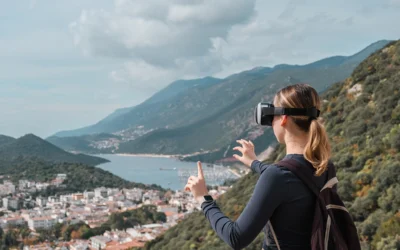
New information is constantly emerging regarding the Metaverse and its application to various economic activities, with tourism standing out as one of the sectors most eager to invest in this technology. This digital transformation presents an opportunity for the tourism sector to revitalize itself, creating new concepts related to immersive travel, allowing users to explore the world from home or enjoy unique experiences that transcend traditional travel. However, for this revolution to succeed, destinations and tourism companies must invest in new immersive tools.
The integration of tourism into the Metaverse will serve, for example, as a showcase for clients to familiarize themselves with a location before visiting it physically, saving costs on business trips, or even taking virtual vacations at a lower price, contributing to a reduction in climate impact. Furthermore, it will also be a valuable tool for institutions, tourism offices, or travel agencies when communicating with tourists interested in learning more about a destination. For example, Barbados will be the first country to have an embassy in the Metaverse to provide services such as virtual visas.
Therefore, we are facing a paradigm shift in the way we travel. However, this does not mean the end of traditional tourism, but rather an alternative or, more accurately, a complement to it.
The Metaverse arrives at FITUR 2022.
The use of virtual experiences for tourism purposes is already a reality, and several examples of this were showcased at the last edition of FITUR, the International Tourism Fair. For example, visitors were able to discover the Helixa Experience Center, a space that allows users to create their personalized avatar to interact with within digital platforms in the Metaverse. This experience is based on the combination of several technologies, including video mapping projections, interactive LED lighting matrices, Optitrack motion capture, olfactory immersion systems, and position control software.
Helixa is based on an immersive journey that shows the relationship between human history and technology. The route is divided into several parts: it begins in a room set up like a prehistoric cave and continues with the industrial revolution and the emergence of transportation. Finally, it delves into the audiovisual era, where we see how media have influenced connectivity and exploration of the world, leading to the Digital Age, with the incorporation of the Internet and mobile devices. The journey concludes in the Metaverse, where users will have the opportunity to create their own avatar through an interactive photocall.
The exhibit showcased at FITUR is part of the Helixa community, a virtual ecosystem designed for the exchange of knowledge and business. This ecosystem aims to be the central hub for innovation within the Metaverse for Spain and Latin America. The initiative encompasses three key areas: Helixa, a virtual ecosystem for knowledge and business exchange; LiveConnect, a digital platform facilitating debate, research, and networking; and Summit, a planned event scheduled for mid-year focused on sharing insights and documenting them for broader dissemination within the business community.
Virtual Reality: A Strategic Investment for Tourism Destinations
Numerous tourism destinations leveraged this opportunity at the trade fair to promote their offerings through virtual reality experiences. Attendees were able to virtually explore activities such as kayaking on the Caleta de Cádiz beach, visiting Medina Azahara in Córdoba, rafting down the Cinca River in Aragón, and participating in a virtual recreation of the traditional board-surfing event in Icod de los Vinos, Tenerife.
These initiatives highlight the potential of the Metaverse to enhance destination promotion and generate business opportunities for tourism companies embracing immersive technologies.
Isostopy has previously worked to strengthen tourism destinations. We developed the application... Zaragoza Tourism VR, an application allowing users to virtually explore three routes covering the key tourist attractions of Aragón (the Basilica of the Pillar, the Expo site, the Roman Theatre, etc.). Additionally, in collaboration with the Instituto Europeo de Diseño de Madrid (IED) for the Perú Design Net festival, we created... Machu Picchu VR, an app enabling virtual exploration of the archaeological site, complemented by a guide detailing the history and function of each building within the city.