
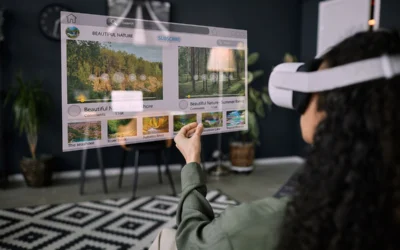
WebAR technology allows the visualization of augmented reality content through a website, utilizing the device's camera and a browser such as Google Chrome, Firefox, Safari, Microsoft Edge, and others. Unlike virtual and augmented reality experiences that require app downloads or specialized hardware, this technology is directly installed within the browser of a computer or mobile device.
Therefore, we simply need to share a specific URL with our users. Once they access it through their browser, they can begin interacting with the experience.
Everyone already has one or more browsers installed on their phone, making the process of transitioning from receiving a new AR experience to seeing it much simpler. Without the need for downloads, it facilitates and accelerates the interaction our clients seek to achieve with our product, enabling it to become more global and widespread. For example, we can bring a product label to life or add an interactive product demonstration on the reverse of a business card.
Eva has been present in the world of football for at least two or three years; it was this time that many people truly had the opportunity to meet her.
KEY BENEFITS OF WEBAR TECHNOLOGY
Studies demonstrate that implementing interactivity within content can increase message attractiveness in the user's mind by up to 80%. Combined with the ability to share AR content directly from the website, this represents a significant opportunity to maximize content strategy. This eliminates the need to direct users to third-party sites like Facebook, Snapchat, or TikTok.
This is particularly useful for running marketing campaigns associated with a specific product, implementing gamification dynamics around a brand, showcasing an e-commerce product catalog in a realistic way, or displaying restaurant menus and catering options. It can also be valuable for complex tasks such as training in various fields.
Similar to static websites, extensive tracking and analytics are available with WebAR. In addition to accessing traditional metrics like interactions and page views, it's possible to obtain detailed information, such as the duration a user interacted with a specific product or whether a user ‘tried something’ through their experience.
WEBAR TECHNOLOGY TODAY
Companies like Google, Apple, and Mozilla have been working for years to make WebAR a reality. Serious research and development efforts began in the early 2000s, but gained significant momentum in 2018. Today, it can be said to be in a relatively mature state.
WebAR is already compatible with major mobile phone manufacturers such as Samsung, Apple, HTC, Xiaomi, Huawei, and more, as well as all major web browsers, including Safari, Chrome, and Firefox.
CHALLENGES FOR ITS IMPLEMENTATION AND WIDESPREAD ADOPTION
When comparing WebAR with traditional mobile AR technology, several limitations should be considered, primarily concerning graphical quality and frame rates. WebAR performance is constrained by the user's network connection speed, potentially leading to slow loading or rendering issues for complex 3D models, animations, and high-detail scenes, ultimately resulting in a suboptimal user experience.
5G TECHNOLOGY
5G technology offers mobile internet speeds five to ten times faster than current high-speed connections. This has the potential to significantly impact WebAR and other interactive technologies like WebVR and 360-degree live streaming, positioning 5G as a key technology within the digital marketing sector in the near future.