
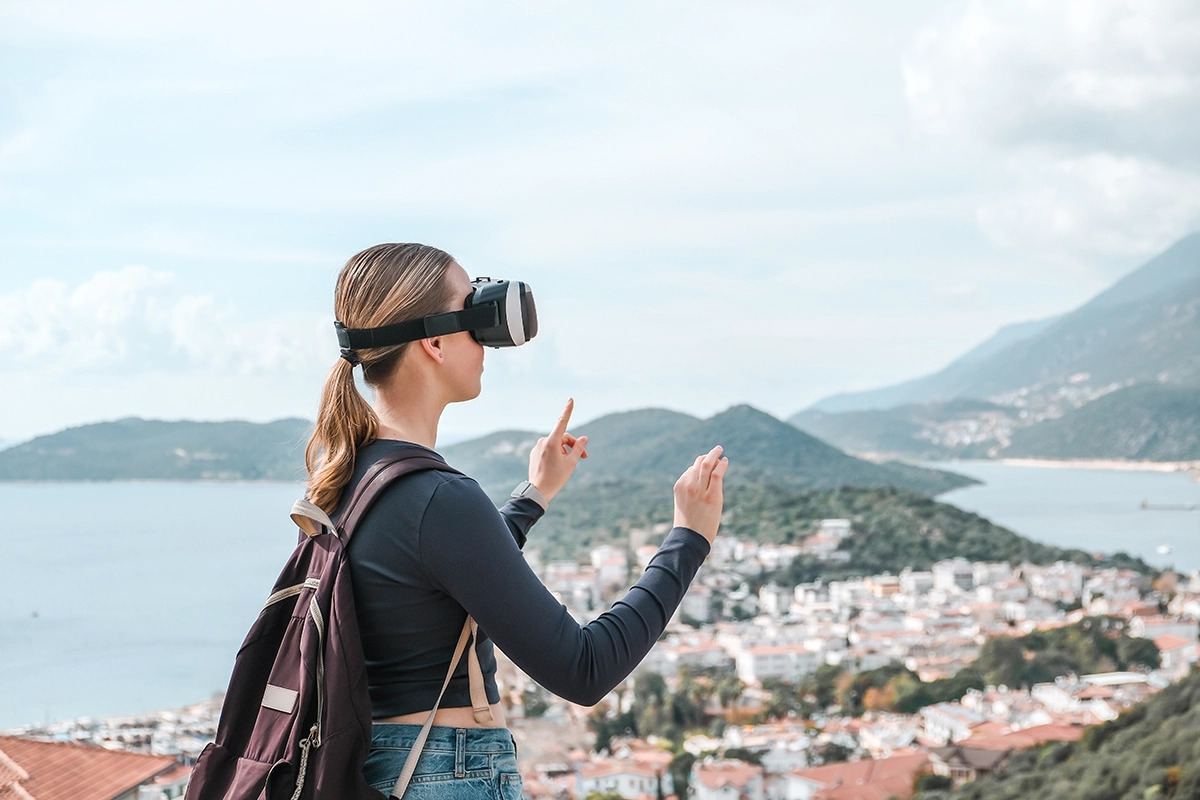
Restrictions on tourism, capacity limitations, and other regulations stemming from the COVID-19 pandemic have accelerated a trend within the cultural sector: prioritizing digital solutions as a core strategy. Specifically, virtual reality (VR) is recognized as one of the most effective ways to continue offering engaging and immersive experiences.
For example, consider Italy, one of the world’s most significant repositories of cultural assets. A 2021 study indicates that nearly half of Italy’s museums and heritage sites plan to integrate immersive technologies into their communication and dissemination offerings within the next few years.
Among the various applications of virtual reality, the reconstruction of historical heritage is a particularly prominent use, providing tangible value to both museums and visitors. This technology allows users to be transported to another time and place, with all the implications for understanding and contextualizing this heritage.
WHAT IS THE PROCESS FOR CREATING A VIRTUAL HERITAGE RECONSTRUCTION?
Broadly speaking, we can define three key steps:
STEP 1: Study and Data Collection
Similar to any traditional restoration or reconstruction project, the initial and fundamental step involves conducting all activities related to documentation and data collection to ensure access to comprehensive information that will enable a rigorous and detailed outcome.
A heritage recreation project typically involves archaeologists, art historians, museum curators, and architects specializing in heritage assets.
STEP 2: 3D Modeling
Once all documentation is gathered and necessary decisions are made, the next step will be to create the three-dimensional models that comprise our virtual reconstruction, whether it’s an interior or exterior space, a singular artifact, or anything else. The market offers a wide range of software, from specialized design tools like Revit and Rhinoceros to those commonly used for creating models for video games or special effects, such as Blender or 3DS Max.
We can identify two additional methods for obtaining our 3D models. Firstly, we can find existing 3D model libraries available for free download or for purchase. In this case, careful attention must be paid to the historical rigor of the model when incorporating it into our reconstruction, as well as the model’s quality.
Furthermore, it's highly interesting when photogrammetry – a technique for reconstructing a 3D model from a large number of photos of an object or space taken from multiple angles – can be utilized. This method provides the highest fidelity to reality, as geometry and textures are directly derived from the original, but significant optimization work will be required to reduce model weight and ensure smooth performance. This technique is particularly valuable for 'virtualizing' well-preserved artifacts such as amphorae and jewelry.
STEP 3: Virtual Reality Experience Development
With the 3D models and necessary resources now available, the focus shifts to reconstructing the virtual environment. This involves adding lighting, materials, and effects to create the desired atmosphere and final appearance of the virtual environment. Programming or animation systems can also be utilized to create interactions with objects and characters, thereby enriching the user experience.
For this process, we can leverage dedicated game engine software, such as Unreal Engine or Unity, which are widely popular in the gaming industry. These engines allow us to create experiences for devices like Oculus Quest, smartphones, and interactive displays.
As noted at the beginning of this article, Italy is already firmly investing in incorporating these technologies into the cultural sector. However, the application of virtual reality to the conservation and dissemination of heritage extends beyond Italy. Other cases offer additional insights into the future of virtual reality.
A notable example is the Dunhuang Caves (also known as Mogao Caves) in China, which contain some of the world's most significant Buddhist murals, dating back over 1600 years. Construction of the Dunhuang Caves began around the 4th century AD. Due to their age, restoring these murals has always been a challenging and complex task. To prevent further deterioration, the museum limited public visits and replaced them with virtual tours, which also allow for the recording of the current state of the caves, ensuring their digital preservation against ongoing damage caused by exposure to the elements.
Within the virtual simulation of the caves, visitors can explore and examine the sculptures and murals closely, creating an immersive experience that also facilitates a better understanding of their historical and artistic context.
Consequently, users can observe the evolution of the murals across different periods. This aspect of the exhibition is particularly noteworthy, as it raises public awareness of how the murals have deteriorated over time.
This experience can be viewed on mobile devices, but is fully appreciated on a virtual reality device such as Oculus Quest or a similar platform.
https://youtu.be/dqu1nJtJXqM
OPEN HERITAGE PROJECT
Continuing its exploration of cultural sites through virtual reality, Google has launched the Open Heritage project in collaboration with CyArk, a non-profit organization. The team utilizes virtual reality to create precise 3D models of heritage sites across dozens of countries, many of which are located in remote, often underserved areas, and subject to governmental restrictions. This initiative provides public access to culturally significant locations that would otherwise be difficult to experience.
Furthermore, this project is enhanced by the inclusion of audio guides and educational games, fostering engagement and learning simultaneously.
CONCLUSIONS
A key benefit of applying virtual reality to heritage dissemination is the immersive experience it provides, akin to a journey through time. This transcends spatial and temporal limitations, forging a connection between the past and the present in cultural communication.
Another advantage is increased accessibility for a broader audience, including individuals with sensory or physical disabilities. It can also be a valuable tool for academics and researchers. For example, the recreation of Milan Cathedral allows users to virtually explore its upper levels, which have been closed since the 16th century.
It’s important to note that some researchers and archaeologists have expressed concerns regarding the accuracy of experiences generated through virtual reality at these sites. A common argument is that the digital reconstruction process isn't always entirely precise, often relying on partial evidence. These researchers highlight that the graphical systems used in virtual reality reconstructions can be overly realistic, potentially leading viewers to overlook the fact that reconstructions are frequently based on assumptions about the appearance of a lost or partially destroyed asset, for which we lack 100% verifiable evidence.
To mitigate these risks, thorough prior research and communication between historians and technical specialists are crucial throughout the process to ensure the accuracy of the virtual reconstruction. Museums should also collaborate closely with their technology teams and emphasize a commitment to rigor in these creations.
Moreover, incorporating graphical scales to display the level of available scientific evidence during the reconstruction process would be beneficial, allowing users to review this information during their experience.
This approach enables museums to maintain the integrity of their exhibits while providing an engaging and immersive educational experience of the past, leveraging a forward-thinking technology that supports heritage preservation and its long-term safeguarding.