
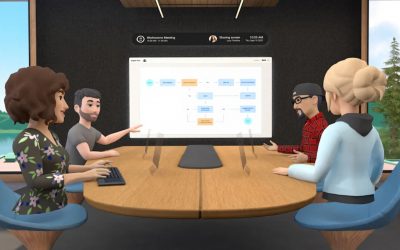
The creation of tools to facilitate communication or content sharing has consistently received enthusiastic reception in the events industry. Meeting or conference organizers have long aspired to create digital experiences as realistic and engaging as possible, mitigating the time and cost disadvantages associated with physical attendance.
In this context, virtual and augmented reality are today's key allies in innovation and the improvement of these types of corporate events and conventions. This technology enables speakers and attendees alike to immerse themselves in an immersive experience, which can be tailored (avatar personalization, space modeling, etc.) using VR headsets with controllers that allow users to interact and participate in the event almost as if they were physically present.
Digital transformation presents opportunities to redefine and improve interpersonal connections, and the use of virtual reality in events facilitates this connection, even virtually.
Advantages
Virtual attendance and increased engagement
Event planning typically depends on several factors, including the need to gather people from different locations. While video conferencing addressed part of this problem, it resulted in colder exchanges and occasional technical issues.
Creating virtual spaces fosters a more natural environment, where event attendees feel physically present in that location, regardless of their actual location.
Furthermore, the ease of attendance – without the need to travel to another city or country – directly impacts participation levels. It is easier and more likely that people will attend an immersive online event than a physical one, as it doesn't require travel or significant schedule adjustments.
Personalization and gamification
Virtual meetings in virtual spaces feature personalized avatars. Users create their visual representation with their preferred characteristics, typically to resemble themselves.
As in real life, characters can move and speak to each other, creating a greater sense of closeness. In events, this feature allows users to take on a more active role, mimicking a real-life experience as closely as possible.
This tool also allows for a degree of gamification within the event, as in video games, the individual controls an avatar. Additionally, some platforms enable the incorporation of additional features, such as games or fun activities, highlighting this playful value.
Differentiation
When launching an event, making a good impression and creating a memorable experience for attendees is a top priority for any organization. However, standing out from other event companies in such a competitive environment has become a challenging task.
In this context, leveraging virtual reality presents a significant opportunity for differentiation in the market. Delivering an immersive, enriching, and bespoke experience will create a lasting, positive impression on attendees and drive increased interest in future editions.
Investing in technology provides a valuable brand image enhancement, enabling companies to attract the attention of key partners and influential figures. Being recognized as a forward-thinking and innovative event will maintain a high level of relevance within the industry.
Platforms
Regarding event creation technologies, two companies stand out for their pioneering work in the metaverse and offering users immersive, three-dimensional spaces of various types: Microsoft and Meta.
Microsoft's platform enables the creation of dynamic, high-fidelity 3D events. Access is available through Oculus VR headsets, Windows Mixed Reality, or directly from a PC in a 2D mode.
This platform is primarily focused on facilitating public and private events with a strong emphasis on social and recreational elements.
Key features include avatar personalization, the creation of customized public and private spaces, screen sharing capabilities for presentations, and robust security and privacy controls.
This portal allows for the creation of mixed reality meetings. Access to virtual offices is possible via virtual reality headsets, as well as through devices such as computers, mobile phones, or tablets.
Key features include avatar personalization, calendar integration, infinite virtual whiteboards, spatial audio immersion (where voice perception changes based on distance), screen sharing, file sharing, and customizable space dimensions.
Creating immersive events as part of a company’s communication strategy is now a feasible and cost-effective approach. Prioritizing a positive user experience and a 3D environment aligned with the event’s nature and objectives is paramount.
Are you interested in creating a virtual event? At Isostopy, we are experts in producing these types of experiences and are available to advise you on all phases of the project, from space design to device acquisition if required, to ensure your event is a success.